![FFD+Logo_cmyk[1]+(2)_edited.png](https://static.wixstatic.com/media/6454fa_d0e95201e13a4f73ab839cd5a9bbb22b~mv2.png/v1/fill/w_320,h_42,al_c,q_85,usm_0.66_1.00_0.01,enc_avif,quality_auto/FFD%2BLogo_cmyk%5B1%5D%2B(2)_edited.png)

Fascia and Soffit Installers Colchester: What Matters

A dripping gutter, peeling paint beneath the eaves or sagging timber at the roofline rarely stays a small job for long. When homeowners search for fascia and soffit installers Colchester, they are usually looking for more than new white boards. They need someone who will find the cause of the problem, protect the roof edge properly and leave the house looking as though the work has always belonged there.
That is where the standard of installation matters. Fascias, soffits and guttering are highly visible, but much of the important work sits behind the boards. A tidy-looking replacement can still cause trouble if rotten rafter feet are covered over, ventilation is ignored or gutters are fitted without the right fall. The cheapest quote is not always the expensive one, but a rushed job commonly becomes exactly that.
What a roofline replacement should actually solve
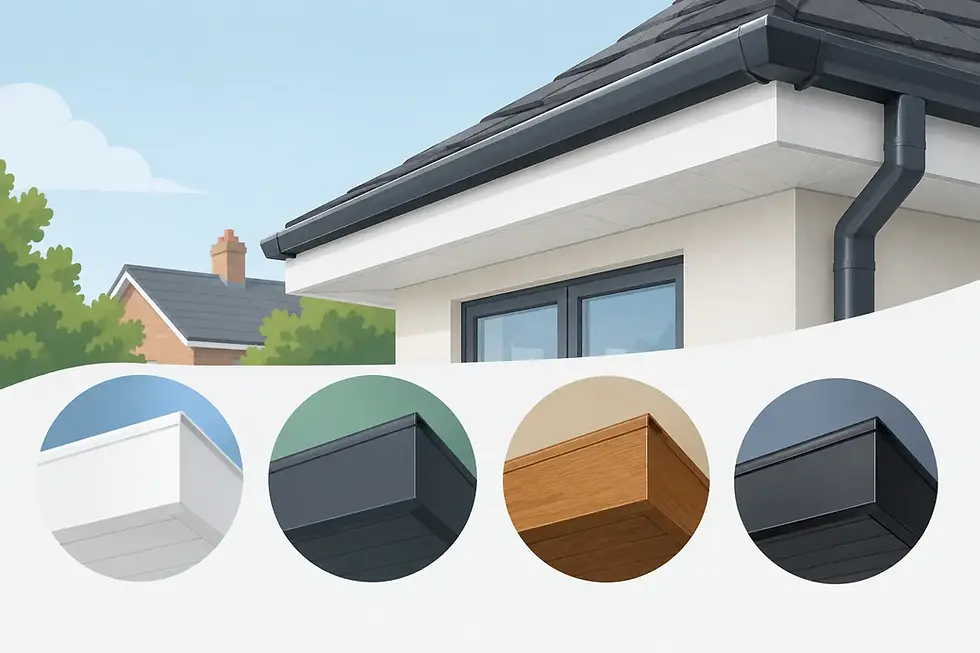
The fascia board runs along the lower edge of the roof and supports the guttering. The soffit is the underside of the roof overhang. Together, they protect the eaves from weather, help ventilate the roof space where required and provide a clean finish between the roof and the walls.
On older homes, timber fascias and soffits may have been painted repeatedly over many years. Once water gets behind failed paintwork or overflowing gutters, the timber can soften and rot. In some cases, the first visible sign is a loose gutter bracket or a dark stain on the brickwork. By then, the damage may extend to the rafter ends behind the fascia.
A proper renewal is not simply a matter of fitting plastic over old timber. Overcladding can be suitable in limited circumstances where the original boards are sound, dry and securely fixed. But it is not a cure for decay. Covering rotten timber traps the problem out of sight and can leave guttering fixed to a weakened edge. For many properties, removing the existing boards is the honest way to inspect what is there and build the new roofline on a sound base.
The hidden checks that protect your home
Good fascia and soffit installers in Colchester should explain that some conditions can only be seen once the old roofline is removed. That does not mean you should expect vague surprises or open-ended charges. It means the quotation should clearly set out how rotten rafter feet, damaged eaves and other remedial timber work will be handled if found.
Rafter feet are the exposed ends of the roof timbers that sit behind the fascia. They are vulnerable when gutters leak or overflow for a prolonged period. If a rafter end has deteriorated, it may need careful repair before new boards are installed. Ignoring it to save time is false economy. The new fascia may look fine on day one, yet its fixings and gutter brackets are only as dependable as the timber beneath them.
The eaves also need to be checked for water ingress, gaps and support. Eaves protection trays can be fitted to guide roof water cleanly into the gutter rather than allowing it to track back on to timber. This is a modest detail with a useful purpose, particularly where older felt has become brittle or does not project far enough into the gutter.
Ventilation is another point that deserves a straightforward conversation. Some roof spaces need continuous airflow at the eaves to reduce the risk of condensation. Others have ventilation provided elsewhere. The right approach depends on the roof construction, insulation and existing ventilation, rather than a one-size-fits-all answer.
The finishing details separate a neat job from a quick one
Most homeowners can spot badly fitted roofline work from the pavement. Uneven joints, heavy sealant lines, exposed screw heads and awkward corners make even new materials look second-rate. More importantly, poorly formed joints create places where water and movement can cause problems over time.
Look closely at box ends, the enclosed sections of fascia and soffit at the end of a roof run. They need accurate measuring, clean cuts and carefully formed corners to look crisp from every angle. A rushed installer may patch together short offcuts, rely on excessive trim or leave mismatched lines. A specialist will aim for single-piece cuts where practical, precise cornering and concealed fixings that keep the finish clean.
Guttering deserves the same care. It should sit straight, with a controlled fall towards the outlet so rainwater drains efficiently without making the gutter look visibly sloped. Brackets need secure fixing at suitable intervals, outlets should be positioned sensibly, and downpipes should take water away without soaking the wall or pooling near the property. If guttering is replaced as part of a full roofline job, it should not feel like an afterthought.
Questions to ask fascia and soffit installers in Colchester
Before accepting a quotation, ask what will happen to the existing boards. A clear answer should tell you whether they will be removed or overclad, why that method is recommended and what condition the installer expects to find behind them.
It is also worth asking how rotten timber repairs are priced. A contractor who says nothing can ever be found beneath old fascias is not being realistic. Equally, you should not be left exposed to unexplained extras. The fairest approach is to inspect thoroughly, include likely remedial work within the original scope where possible and discuss anything genuinely unforeseen before it is carried out.
Ask to see examples of completed work, particularly corners, box ends and gutter lines. Photographs are useful, but local references and previous installations give a far better sense of how a business works. A family-run firm should be happy to stand behind its workmanship because its reputation travels quickly across Colchester and the surrounding Essex villages and towns.
Finally, check what materials and fittings are included. The colour and profile of the fascia, soffit style, gutter shape, downpipes, ventilation provision, bird guards and eaves protection can all affect the finished result. A quote that appears lower may simply leave out the parts needed to complete the job correctly.
When repair is enough and when replacement makes sense
Not every roofline needs a complete replacement. A localised gutter leak, a broken bracket, a slipped joint or minor timber damage can sometimes be repaired effectively. If the main boards remain solid and the problem is isolated, repair may be the sensible choice.
Replacement becomes more attractive when there is widespread rot, repeated gutter failure, flaking paint across several elevations or a roofline that has reached the point where ongoing maintenance is becoming a burden. It can also make sense when homeowners are improving cladding, windows or external decoration and want the whole property to look consistent.
There is a trade-off. A full replacement costs more upfront than a small repair, but it can remove recurring painting, protect vulnerable timber and give the exterior a cleaner, more finished appearance for years to come. The right decision should be based on the actual condition of the eaves, not a sales pitch.
A straightforward standard for your home
At Fascia Fit Direct, the aim is not to make roofline work sound complicated. It is to make sure homeowners know what they are paying for: sound preparation, careful remedial work where needed, properly fitted fascias, soffits and guttering, and a finish that does not rely on a ‘that’ll do’ attitude.
Your home should not be used as a shortcut or a learning exercise. Choose an installer who will inspect closely, explain plainly and take pride in the details that remain visible long after the ladders have gone.


Comments