![FFD+Logo_cmyk[1]+(2)_edited.png](https://static.wixstatic.com/media/6454fa_d0e95201e13a4f73ab839cd5a9bbb22b~mv2.png/v1/fill/w_320,h_42,al_c,q_85,usm_0.66_1.00_0.01,enc_avif,quality_auto/FFD%2BLogo_cmyk%5B1%5D%2B(2)_edited.png)

Cost to Replace Fascias, Soffits & Guttering

A leaking gutter can look like a small nuisance until the water starts staining brickwork, soaking the eaves and finding its way into tired timber. The cost to replace fascias, soffits and guttering is therefore about more than making a house look smarter. It is an investment in keeping water where it belongs and preventing a manageable roofline job from becoming a larger repair.
For homeowners across Essex and Suffolk, a complete replacement commonly costs from around £2,500 for a straightforward smaller property to £6,000 or more for a larger detached home with complex rooflines. That is a useful starting point, not a price promise. The true figure depends on the size and shape of the property, access, the materials selected and, crucially, what is found behind the old boards.
A careful contractor should inspect before quoting and explain the likely allowances. The cheapest figure on paper is not always the cheapest job once poor fixings, rotten rafter feet or surprise add-ons enter the picture.
What does a full roofline replacement include?
A proper roofline renewal usually involves removing the existing fascia boards, soffit boards and guttering, then fitting new uPVC fascias and ventilated soffits where required. New gutter runs, downpipes, brackets and stop ends should be included, together with the trims and finishing pieces that make the installation look neat from the ground.
The fascia is the main board fixed along the lower edge of the roof. It supports the guttering and protects the ends of the rafters. The soffit is the underside section between the wall and fascia. It closes the eaves, helps keep birds and insects out, and can provide ventilation to the roof space.
This distinction matters because replacing guttering alone may stop an immediate overflow, but it will not solve failing fascia boards or a poorly ventilated eave. Equally, simply capping new plastic over old rotten timber can hide a problem rather than deal with it. A replacement should start with removal and inspection, not with covering everything up and hoping for the best.
Typical cost to replace fascias, soffits and guttering
Every home needs measuring on site, but the following broad ranges can help homeowners sense-check a quotation for supply and installation of a complete uPVC roofline system.
A small terraced house or compact bungalow with easy access may fall around £2,500 to £3,500. A typical semi-detached house is often in the region of £3,000 to £4,500. For a larger detached property, prices frequently start around £4,500 and can rise beyond £6,000 where there are multiple gables, conservatory junctions, high access requirements or extensive remedial work.
Those figures assume a full replacement rather than a quick gutter swap. Colour choices, heavy-duty gutter profiles, extra downpipes, cladding work and eaves protection can all affect the final amount. Homes with a number of attractive but awkward details - bay windows, porch roofs, dormers and shaped box ends - take longer to finish properly.
It is tempting to compare quotes only by the overall total. Instead, compare what each contractor has allowed for. Are all gutters and downpipes included? Is removal and disposal of old materials stated? Is any remedial timber work included if needed? Are access equipment, VAT and finishing trims clear? A quote that leaves these points vague gives too much room for an unpleasant conversation once work has started.
Why metre rates rarely tell the full story
Some firms advertise a price per metre. It can be useful as a rough guide, but it does not account for the details that separate a tidy, lasting job from a rushed one. A straight rear eave is very different from a front elevation with bays, returns, hips and several downpipes.
Corners need to be square, joints need room for normal expansion and gutter falls need setting accurately so water runs to the outlets. Box ends at the gable should be formed cleanly rather than pieced together with obvious joins. These are not decorative extras. They are the visible evidence of care and they influence how well the roofline performs over time.
The factors that change your quotation
The size of the roofline is the obvious factor, but access can be just as significant. A bungalow may have more linear metres than a small house yet be quicker and safer to reach. A tall three-storey property, a restricted side passage or a roof over a conservatory may require specialist access arrangements and more labour time.
The condition of the existing timber is another major variable. Water overflowing from old gutters often runs back over the fascia and into the rafter ends. Once the old boards are removed, a good installer can see whether the rafter feet and eaves are sound. Localised repairs may be straightforward. More widespread decay needs properly dealing with before new boards are fixed.
This is why a sensible quotation should address remedial work openly. At Fascia Fit Direct, foreseeable repairs to rotten rafter feet and eaves are assessed as part of the original job rather than used as an excuse for inflated extras after the work begins. No one can see every hidden issue before removing old boards, but homeowners deserve an honest explanation of the risk and how it will be handled.
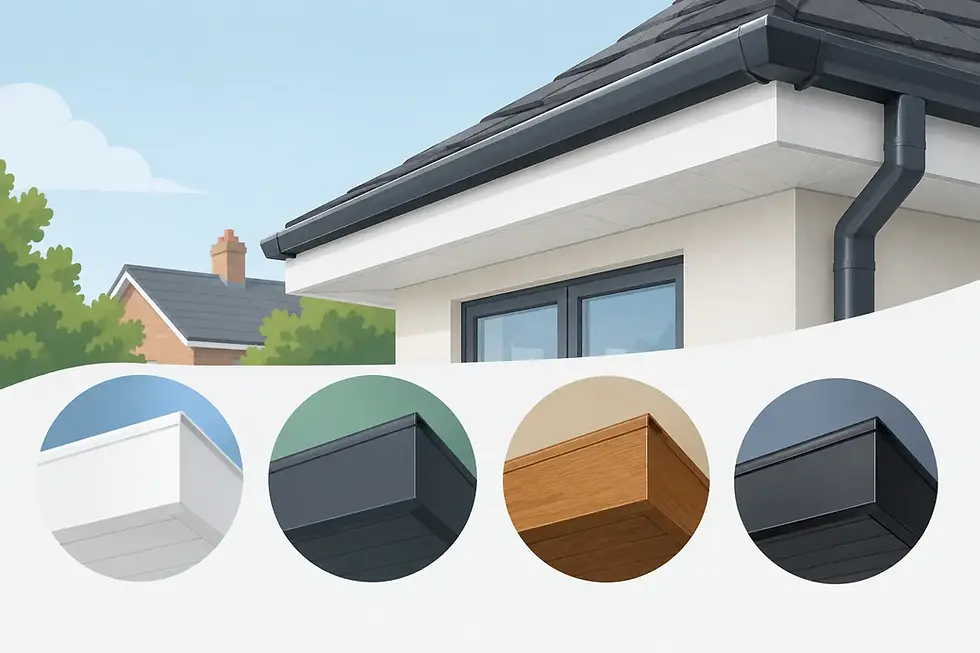
Material choice also affects price. White uPVC remains a practical, popular option, while anthracite grey, black, woodgrain finishes and contrasting boards can cost more. The gutter profile matters too. A larger capacity system may be worthwhile where roof areas are broad or where heavy rainfall repeatedly overwhelms older gutters.
What good installation looks like from the ground
You do not need to be a roofline specialist to spot signs of care. Stand back and look along the fascia line. It should appear straight and consistent, with clean corners and no sagging gutter runs. Downpipes should sit neatly against the wall, and gutters should not hold standing water after rainfall.
Look closely at the ends of gables and porches. A well-made box end has crisp lines and considered joins, not a collection of short offcuts assembled to get the job finished. Where possible, single-piece cuts create a cleaner appearance and reduce unnecessary joints. Concealed fixings and accurately fitted trims also give the work a far more finished result.
Behind that appearance, the essentials are equally important. The fascia must be fixed securely into sound structure, not weak timber. Gutters must be supported at suitable intervals and set to a correct fall. Soffit ventilation needs to suit the roof construction, particularly where insulation has reduced airflow at eaves level.
A contractor who is happy to show previous local work is usually confident about these details. Your home is their best advert, so it is reasonable to ask to see the standard you will receive.
Is repair ever better than replacement?
Sometimes, yes. A loose gutter bracket, split union, leaking downpipe or isolated section of damaged timber can often be repaired without replacing an entire roofline. If the fascias are sound, the guttering is correctly sized and the issue is contained, a repair can be the sensible, economical choice.
Replacement becomes better value when several problems arrive together: peeling or swollen timber, recurring leaks, gutters pulling away, widespread staining, poor drainage and old boards that have already been patched more than once. Repainting timber fascias may look cheaper initially, but it involves ongoing preparation, painting and maintenance. If water has already reached the timber behind, cosmetic work will not put it right.
The right answer depends on condition, not on pushing every customer towards the largest job. A site visit should give you a clear recommendation and the reasons behind it.
Questions worth asking before you accept a quote
Before choosing an installer, ask whether the old boards will be removed or overclad, how rotten timber will be dealt with, and whether all guttering components are included. Confirm how access will be managed, whether waste removal is covered and how long the work is expected to take.
It is also worth asking how the company forms box ends, handles corners and fixes the new fascia. These may sound like small technical points, but vague answers often reveal a ‘that’ll do’ approach. A specialist should be able to explain the work in plain English without brushing off reasonable questions.
Finally, do not be afraid to ask about workmanship standards and local references. A family-run firm that relies on recommendation has every reason to communicate clearly, turn up when promised and leave the property looking as though the work belongs there.
A roofline replacement should leave you with straight boards, free-flowing gutters and no anxious glance upwards whenever heavy rain arrives. Take the time to choose a quote that covers the whole job properly - including the awkward parts hidden behind the old fascias - and you are far more likely to pay for the work once, rather than paying to put it right later.


Comments